

- This guide offers a rundown of resources, including small business energy grants and programmes, aimed at helping your business save money and use energy more efficiently.
- By leveraging these opportunities, you can cut costs and advance your business’s environmental sustainability efforts.
- While the energy market is no longer as turbulent as it was in 2022, businesses should still be vigilant and take advantage of any opportunities to save money.
While much has been said about the UK’s ongoing cost of living crisis — and rightfully so, as the average person in Britain was nearly £2,000 worse off in 2023 — what is probably not getting talked about enough is the spiralling cost of doing business.
Much of the problem is driven by one key factor: energy.
Soaring business energy prices, triggered by the Russian invasion of Ukraine, have forced the closure of more than 4,500 hospitality premises from 2022 to early 2023. And while the energy market has stabilised to some extent, small businesses will likely continue feeling the pinch in 2024 — and possibly beyond.
Related Reading: How the Russo-Ukrainian war is affecting energy costs
In April last year, The Guardian reported that more than one million small businesses across the UK may be paying energy bills higher than the average market rates after locking themselves into long-term contracts, fixed when energy rates reached record highs in the previous year.
At Renew and Sustain, supporting small businesses through their energy challenges is at the heart of our mission. This commitment has never been more crucial as you navigate the ongoing cost of doing business crisis. In this guide, we’ve compiled a list of small business energy grants, resources and programmes — all of which aim to provide businesses like yours with relief and assistance.
Related Reading: Energy support for businesses: A look at your options
UK Government-backed energy support schemes for small businesses
The government offers various support schemes designed to help small businesses navigate the complexities of energy efficiency and sustainable development. These initiatives range from loans and grants to subsidised programs, all aimed at helping businesses manage costs effectively while reducing their environmental impact.
Energy Technology List (ETL)
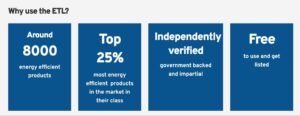
The Energy Technology List (ETL) initiative assists businesses and the public sector in the UK with choosing environmentally friendly energy solutions. Offered at no cost and supported by the Department for Energy Security and Net Zero, it stands as one of the world’s most extensive compilations of energy-conserving technologies.
Source: Energy Technology List
The ETL grants access to approximately 8,000 rigorously tested and carefully evaluated energy-efficient products. If you’re in the market for energy-efficient products or seeking unbiased advice on energy conservation, the process is straightforward: search, discover, and compare options to gain comprehensive insights along with contact information for manufacturers or suppliers.
The Smart Export Guarantee (SEG) scheme
The Smart Export Guarantee (SEG) scheme represents another cost-saving opportunity for small businesses. This initiative enables businesses producing their own renewable energy, through solar panels or wind turbines, for example, to sell surplus energy back to the grid. It encourages the adoption of renewable energy sources by providing an additional revenue stream, making it a financially viable option for many.
Boiler Upgrade Scheme
Launched in April 2022, the Boiler Upgrade Scheme is a significant £450 million initiative by the UK Government, forming a key part of the broader £3.9 billion Heat and Buildings Strategy.
This grant program aims to assist homeowners in transitioning from traditional fossil fuel heating systems to more sustainable, low-carbon alternatives. Eligible installations include air-source heat pumps, ground-source heat pumps, and biomass boilers, with the scheme providing financial support for these upgrades through to 2028.
The primary goal of this incentive is to encourage more homeowners across England and Wales to adopt green heating solutions. This move is expected to significantly contribute to the national objective of reducing household carbon emissions to net zero by 2050, aligning with broader environmental targets.
Energy Bills Discount Scheme (EBDS)
The Energy Bills Discount Scheme (EBDS) is the government’s latest initiative to support businesses grappling with escalating energy costs. Launched on April 1, 2023, this program replaces the Energy Bill Relief Scheme, marking a shift in approach towards aiding businesses.
Rather than implementing a cap on business energy prices, the scheme provides reduced unit rates for fixed-price contracts initiated from December 1, 2021, onwards, including deemed and out-of-contract rates, all contingent upon meeting a specific minimum threshold.
This initiative aims to reduce operational costs and encourages a shift towards renewable ener
gy sources, aligning with the UK’s Net Zero targets. By fostering energy efficiency, the scheme ensures businesses can reallocate savings towards growth and investment, enhancing their market competitiveness.
While the scheme is set to end in March 2024, its emphasis on sustainable energy practices is expected to yield long-term financial benefits for businesses.
Local council initiatives and business case submission
You can find funding opportunities or grants to promote energy efficiency and sustainable growth by checking with your local council. For example, East Sussex County Council is funding a grant scheme managed by the Sustainable Business Partnership CIC aimed at assisting businesses in lowering their energy use and reducing greenhouse gas emissions.
However, if you’re looking to secure financial support for implementing green technologies or practices, prepare to submit a detailed business case. This should outline how your improvements will contribute to sustainability goals, detailing the expected impact on your energy consumption and carbon footprint. A well-crafted submission focusing on these elements can significantly improve your chances of receiving support.
Energy suppliers’ grants and services
Your energy provider might have specific schemes or grants designed to enhance your business’s energy efficiency. The availability of these programs can vary, with factors such as your business’s size, location, and sector influencing eligibility. Reaching out directly to your energy supplier will let you discover any initiatives they offer, ranging from financial grants to support services like energy audits. These audits can pinpoint areas where you can improve efficiency and reduce energy costs.
Additional grants and support services
Apart from government and energy supplier programs, there are various platforms to help you find grants and support services for energy efficiency.
Services like Grants Online and Let’s Talk provide directories and advice on accessing funds, including those from charities. They can navigate you through the application process for grants supporting a broad spectrum of energy-saving projects. Furthermore, the Waste and Resources Action Programme (WRAP) might offer grants and investments to reduce your business waste and enhance your sustainability efforts. Exploring these resources can uncover valuable opportunities to reduce energy costs and improve your environmental impact.
If you need a team to help you reduce your business energy costs and transition to renewable energy, talk to the business energy consultants from Renew & Sustain. We are ready to provide personalised, round-the-clock support for all your business energy needs. Get in touch with our team to request a free, no-obligation quote.
