

Updated October 2023
- Soaring energy prices, beginning in 2021, are finally cooling off this year, with Ofgem announcing another reduction in the energy price cap for October to December 2023.
- Despite news of gas prices falling, there has been a recent spike in spot prices on European benchmarks.
- Renew & Sustain breaks down the factors that could influence gas prices heading into winter.
In a significant development set to bring much-needed relief to households across Great Britain, the UK’s energy regulator, Ofgem, has unveiled a fresh reduction in the energy price cap for the fourth quarter of 2023 (October to December). The announcement, made in August 2023, puts to rest predictions earlier in the year that winter bills would once again rise.
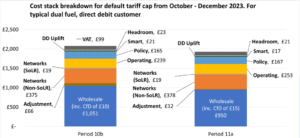
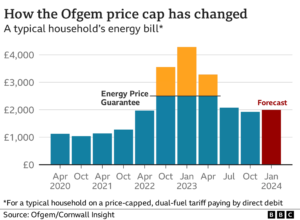
The latest adjustment to the price cap is set to bring the average annual dual-fuel energy bill to under £2,000 for the first time since April 2022, delivering an average saving of £151 compared to the previous quarter.
Starting 1 October and continuing through 31 December, the price cap will be established at an annual rate of £1,923 for dual fuel households paying their bills via direct debit. This calculation is based on the current typical domestic consumption values (TDCV) rate.
Here’s a breakdown of the new caps for various payment methods:
Ofgem energy price cap between July to December 2023 across different payment methods
| Direct Debit | Prepayment | Standard Credit | Economy 7 (electricity only Direct Debit) | |
| July – Sept 2023 cap | £2,074 | £2,077 | £2,211 | £1,400 |
| Oct – Dec 2023 cap | £1,923 | £1,949 | £2,052 | £1,298 |
Related Reading: UK Energy Crisis: The Latest News and How Businesses Can Adapt
Energy price cap returns to 2021 levels
Source: Ofgem
This reduction in the energy price cap is the lowest level since October 2021 and is a result of ongoing decreases in wholesale energy prices. The energy market has been stabilising, and suppliers are gradually returning to a more financially robust position after experiencing four years of financial losses.
Ofgem has made it clear that it expects all energy suppliers in the country to continue enhancing their customer service, providing support to their most vulnerable customers, and fortifying their financial resilience. This proactive approach is intended to prevent the kinds of failures witnessed in the energy sector two years ago. The agency acknowledges that there are instances of excellent best practices within the sector but anticipates these practices to become the industry norm while subpar practices are phased out.
In addition to the price cap adjustments, Ofgem has implemented measures aimed at reducing costs for prepayment metre customers and ensuring extra support for those at risk of disconnection from the energy network.
These savings, made possible by the quarterly updating of the price cap, continue the downward trend in energy prices since their peak at £4,279. However, it’s worth noting that the current price cap remains considerably higher than the pre-energy crisis average in 2021, and the energy market continues to exhibit volatility.
Related Reading: Russia Doesn’t Plan to Raise Gas Deliveries to Europe
Suppliers expected to support their customers this winter
Source: BBC
“It is welcome news that the price cap continues to fall. However, we know people are struggling with the wider cost of living challenges, and I can’t offer any certainty that things will ease this winter,” said Ofgem CEO Jonathan Brearley.
However, Brearley also noted there are signs the financial outlook of energy suppliers is normalising and reasonable profits are expected to make a comeback. Paired with Ofgem’s addition of an allowance to Earnings Before Interest and Tax (EBIT), the regulator believes suppliers don’t have any excuse not to be doing all they can to support their customers this winter.
What does this mean for businesses?
While this development is good news for residential consumers, businesses face a different situation. For starters, the energy price cap is a tool used by Ofgem to protect consumers — not businesses. As a result, many business owners have found themselves receiving gas and business electricity quotes upwards of 50/kWh, making it difficult to keep operations going.
In response, the government rolled out a scheme to provide business owners with much-needed relief. From 1 October 2022 to 31 March 2023, businesses had their energy costs fixed through the Energy Bill Relief Scheme (EBRS). In April this year, the EBRS was replaced with the Energy Bills Discount Scheme (EBDS), a discount system on wholesale energy prices (instead of a cap on costs) running until March 2024.
However, with the energy market stabilising and suppliers expecting reasonable profits once more, businesses should be in a better position to negotiate better terms on their business energy contracts — more so if they secure the assistance of a business energy consultant for their procurement needs. Businesses in sectors with higher than average energy usage, such as glass, ceramics and steel manufacturing, will get a larger discount than others.
If you need a team to guide you through the complicated landscape of business energy procurement, talk to the energy consultants from Renew & Sustain. We’ll work with you to procure the best energy deal designed specifically for your needs. Whether you’re a micro business or a big enterprise, we’re here to help you. Get in touch with our team to request a free, no-obligation quote.
