
Updated September 2023
- After consecutive rises beginning in 2021, UK energy prices finally cooled down this year.
- On 1 July 2023, the energy price cap was reduced to £2,074, and it will decrease again on 1 October 2023 to £1,923, where it will stay until 31 December.
- Nonetheless, this is notably higher than the levels seen in late 2021, before the onset of the energy crisis.
As the looming UK energy crisis casts a dark shadow over the country, experts predict that electricity and gas prices will only stabilise in the next decade. Compounded by the ongoing rising cost of living, analysts from Cornwall Insight predict that consumers and businesses will have to brace for an extended period of elevated energy costs that will undoubtedly squeeze already-strained operating budgets.
The Government’s Energy Price Guarantee (EPG), first introduced in October 2022, has been a bulwark against such crippling prices. However, its sustainability is in question. Citing government figures, The Times reports that the energy price guarantee will cost £25 billion in its first six months and another £13 billion from 2023-24. While this colossal sum will initially be absorbed into government borrowing, the long-term implications are clear — the taxpayers will bear this burden over the following decades.
Why are energy costs still so high?
Wholesale gas prices, which determine the cost energy suppliers incur for gas, have risen for several reasons. However, three factors have been particularly impactful:
- Pandemic-induced lockdowns
- Unusually cold winter seasons
- Geopolitical disruptions, including Russia’s 2022 invasion of Ukraine.
Related Reading: Russia Doesn’t Plan To Raise Gas Deliveries To Europe
Spikes in wholesale gas prices are not unusual. More often than not, suppliers pass these increases on to customers through higher bills. To prevent price gouging, mechanisms such as the Ofgem energy price cap — and more recently the EPG — kept in check how much costs could be passed on.
However, the economic impact of the pandemic and the Russo-Ukrainian War have created an unprecedented spike in wholesale gas prices, leading Ofgem to be criticised for failing to regulate the energy supplier market.
UK energy crisis update: How much Will domestic customers pay for energy in 2023?
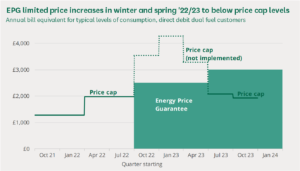
Source: The House of Commons Library
The EPG dictates maximum costs per unit, while Ofgem’s price cap determines daily standing charges.
Usually, the EPG’s amount is given annually, representing what a typical dual fuel direct debit customer would pay over a year if rates stayed consistent. Initially, it was set at £2,500 for two years (October 2022-September 2024) but was revised to £2,500 for the initial nine months (October 2022-June 2023) and then £3,000 for the next nine (July 2023-March 2024).
The £400 Energy Bill Support Scheme mitigated the EPG’s price hikes, disbursed in six monthly portions from October 2022 to March 2023. The Government, in the Spring Budget 2023, postponed the anticipated 20% EPG hike from April to July 2023.
Without the EPG, bills under the price cap would’ve been higher from October 2022 to June 2023. The July-September 2023 price cap is £2,074, lower than the EPG, benefiting customers with standard tariffs. This cap is set to fall further to £1,923 from October to December 2023.
Ofgem energy price cap between July to December 2023
| Current price cap level
(July to September 2023) |
New price cap level
(October to December 2023) |
|
| Price cap level | £2,074 | £1,923 |
| Amount customers pay | £2,074 | £1,923 |
How Does the UK Energy Crisis Affect Businesses?
Unfortunately, business energy prices are not capped. However, the government does provide relief through discounts on business energy unit rates. From 1 October 2022, businesses received support through the Energy Bill Relief Scheme (EBRF). In April this year, the EBRF was replaced by the Energy Bills Discount Scheme (EBDS). According to the government, the EBDS comprises three components:
- The baseline discount offers eligible non-domestic customers some support with their energy bills automatically.
- The Energy and Trade Intensive Industries (ETII) discount offers increased support to businesses and organisations in eligible sectors. Businesses will have to apply for this support.
- The Heat Network discount offers a higher level of support to heat networks with domestic end consumers.
Measures businesses can use to adapt to the UK energy crisis
For businesses, the journey towards energy efficiency is a combination of technology adoption and behavioural change. We recommend addressing these issues through these simple measures:
1. Conduct an energy audit
An energy audit can be a game-changer for businesses aiming to minimise their energy consumption and costs. It’s a comprehensive assessment that clearly shows where and how energy is being used within a facility. Using this information, businesses can identify areas of wastage and inefficiency, paving the way for more informed decisions regarding energy-saving measures. Energy audits can also be a valuable tool for switching to renewable energy solutions — telling you where opportunities for alternative energy sources can be used.
2. Integrating energy-saving technologies
The rapid evolution of technology has presented businesses with a wide range of energy-efficient solutions. Investing in energy-efficient appliances, like high-efficiency HVAC systems, refrigerators and computer equipment, can drastically reduce your energy consumption. These appliances, though sometimes higher in initial cost, offer long-term savings in terms of energy usage and costs.
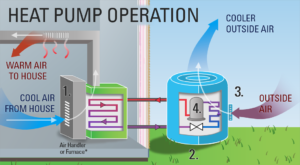
Source: 2040 Energy
One recent solution in the news is the heat pump — a device that uses a refrigeration cycle to transfer heat from one space to another. However, like most new technologies, they have a high upfront cost. According to the Eco Experts, an air source heat pump typically costs around £10,000, while a horizontally installed ground source heat pump will set you back £24,000, on average.
Fortunately, the Boiler Upgrade Scheme can slash £7,500 off the total cost of installing a heat pump for domestic and non-domestic uses.
3. Cultivating energy-saving habits
While technology plays a critical role, the daily practices of individuals within a business can profoundly impact energy consumption.
Simple habits like turning off lights when leaving a room, unplugging devices when not in use and being mindful of heating and cooling settings can collectively lead to substantial energy savings. For instance, adjusting thermostats by a few degrees during non-operational hours or using natural light can substantially reduce energy bills.
Business owners can also initiate employee awareness campaigns to encourage these habits, ensuring everyone participates in the company’s energy conservation efforts.
Preparing for an uncertain business energy landscape
As the UK grapples with an unprecedented energy crisis, businesses must adapt and put their foresight to the test. While every business is different, you will no doubt need a combination of immediate and long-term strategies to navigate the turbulent months ahead.
From harnessing the power of energy efficiency measures and renewable sources to capitalising on the benefits of flexible work arrangements and collective action, businesses have a myriad of tools at their disposal. However, the most vital takeaway is the urgency of action. Waiting in the wings is no longer an option; the future demands proactive measures.
If you need a team to guide you through key decisions that will help you save energy and money, talk to the energy management experts from Renew & Sustain. Allow us to conduct a comprehensive energy assessment of your business and spot opportunities for renewable energy. Get in touch with our team to request a free, no-obligation quote.
